 Banchi and Bell (2008) state that a structured inquiry activity is one in which “the question and procedure are provided by the teacher; however, students generate an explanation supported by the evidence they have collected” (p. 26). In my inquiry lab on circuits, the question that students are answering is “How can you make the bulb light?” I have not provided the students with a procedure for lighting the bulb, but I am not requiring the students write a procedure either. It is possible that this lab would actually be classified as a guided inquiry activity because of the lack of procedure. Students are required to experiment, generate an explanation of how they were able to make the bulb light, and collect evidence of how circuits work.
 Our opening "engage" discussion about what a circuit is and how a flashlight works was successful and enlightening. The students knew much more about flashlights and how they operate than I suspected. They were able to draw on their previous knowledge of positive and negative charges and apply that knowledge to the batteries and how they work; why the positive and negative terminals had to touch and why it could not be negative to negative or positive to positive.
 Students had a hard time transferring the information they discussed about what a circuit is to the lab activity. Students were not creating "circular" circuits. Many of their circuits were line segments and their bulbs were not lighting. Students were getting frustrated when they could not get their bulbs to light. After letting the students struggle with their materials they were able to figure out how to get the bulbs to light and would shout out exclamations of joy such as "It's lighting!" or "We did it!"
 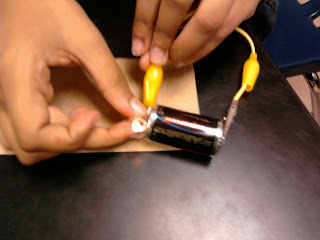 The amount of time that was required for my students to complete the explore activity was more that I realized. Students needed closer to 20 minutes to complete the explore activity as opposed to the 5 minutes that I had originally allowed in my plan. Because of this additional time, we were unable to complete the elaboration activity and will be completing that portion of the activity tomorrow. At the conclusion of our explore lab I had the students draw one of their circuits on the SmartBoard and we discussed problems that we encountered with the circuits and discoveries that we made.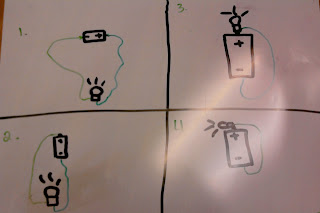
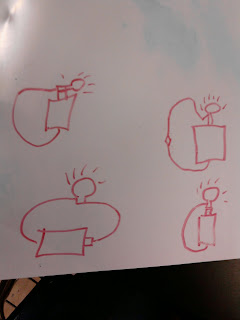
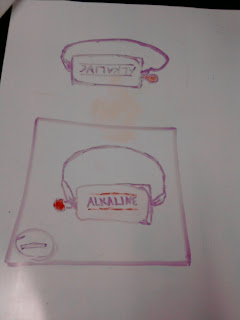 Student discussed the problem of not creating a circuit but a line, they discussed not having the correct part of the bulb touching the battery and the wire (we elaborated on this idea and discussed how a light bulb works), and some groups hypothesized about adding extra bulbs and extra batteries to their circuits.
When I plan inquiry labs in the future I will set aside more time in my planning for the explore activity and will allow ample time for the elaboration process as well. It was very difficult to allow my students to struggle through the creation of their circuits but being patient and not providing them with information showed that they could work through it and this made it easier for me to do in the future. This experience further demonstrated to me that I cannot take my students knowledge, or lack of knowledge, for granted and I should not assume anything about their prior experiences.
Overall, I feel the lesson went well. I performed this lesson with all six of my classes and was able to fine tune the lesson as the day progressed. We discussed a lot of real-world applications of circuits and I feel this helped the students retain the information better and take a more invested interest in the explore activity.
The students were able to successfully create their circuits, find new ways to make the circuits, and finally draw their circuits. Students were able to explain their drawings orally, ask pertinent questions about circuits and their applications, and feel confident in their ability to use their knowledge of circuits to solve the "circuit puzzles" in tomorrow's elaborate activity.
Additional time is needed for exploration and elaboration. In the future, I would like to give each lab table a flashlight so that they can explore the parts of the flashlight up close. Maybe we would discuss the flashlight and how it is a circuit before hand, and then have them explain how the flashlight works in detail after they have been able to create their light bulb circuits. Possible revisions could include having students hypothesize about and draw what configuration they think will make the light bulb light and then have them test their hypotheses using the equipment.
References
Banchi, H., & Bell, R. (2008). The many levels of inquiry. Science and Children, 46(2), 26–29.


